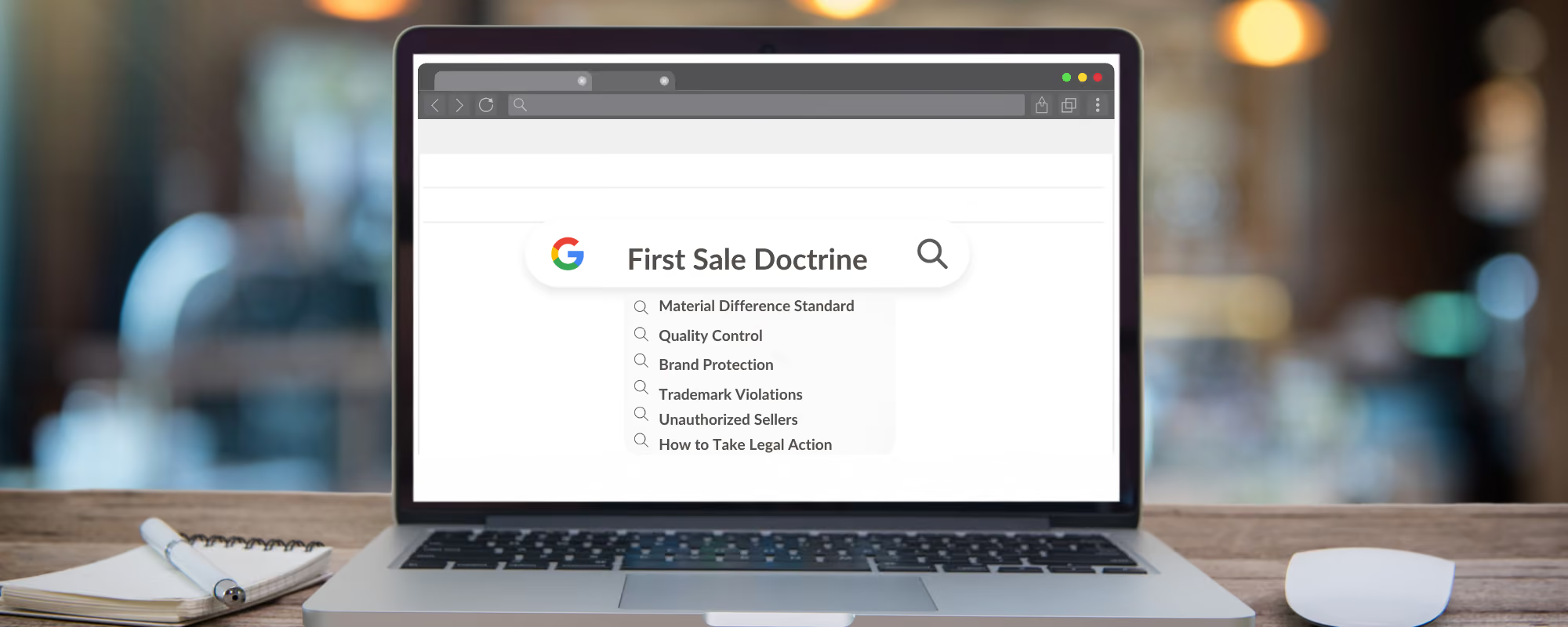
Legal Briefs Podcast: Using the DMCA to Remove Unauthorized Sellers
March 27, 2023
Listen to the episode
A DMCA takedown notice can get an unauthorized seller's copyrighted product images pulled from a marketplace fast, unless that marketplace is Amazon. Jeremy Richardson explains the loophole in Amazon's seller agreements, and how brands can close it.
The Digital Millennium Copyright Act gives copyright owners a fast, practical tool against unauthorized sellers using their marketing images without permission: send a takedown notice to the marketplace, and it has to act quickly or lose its own liability shield. Jeremy Richardson walks through the five required elements of a valid notice and confirms a detail many brand owners don't realize: copyright registration isn't required to send one, though it's still worth doing for the added protections it brings.
The most consequential part of the episode is Amazon's contractual workaround. Amazon requires brands who sell through it to grant a sub-licensable license to their product images and text, meaning any third-party seller on Amazon effectively inherits permission to use those same images, closing off the DMCA as a tool against them. The exception: brands who don't sell to Amazon directly, and whose retailers and distributors haven't granted that sub-license either, retain full DMCA leverage against unauthorized Amazon listings using their copyrighted images. The fix, per Jeremy: build language into every reseller and distributor agreement limiting retailers to using only the brand's approved images, without any right to sub-license them onward.
- DMCA covers copyright only: not trademarks or patents, though many platforms will still act on those under their own policies.
- No registration required to send a takedown notice, though registering copyrighted images/text still adds real legal benefits.
- A valid notice needs five things: identification of the infringed work, description of the infringing activity/link, a good-faith statement, an accuracy/authorization statement under penalty of perjury, and contact information/signature.
- Amazon's loophole: its seller agreement extracts a sub-licensable image/text license from brands, which flows through to third-party sellers, blocking a DMCA claim against them.
- The fix: reseller and distributor agreements should grant retailers rights to use brand images without any ability to sub-license them further downstream.
Full Episode Transcript
[00:00] Welcome to MapTrap's legal briefs, the podcast where we explore specific strategies and tactics used by brands to protect their pricing, distribution, and intellectual property. The information in this podcast is provided for general informational purposes only. It is not legal advice. Listening to this podcast does not create an attorney-client relationship between you and MapTrap's guest presenters. Listeners should seek legal advice from a lawyer licensed in the listener's state.
[00:34] Hello and welcome to another legal briefs podcast. Today's episode will explore the DMCA Digital Millennium Copyright Act. What is it?
[00:49] How can it be used to get rid of unwanted sellers?
[00:53] To shed some light on the DMCA, we're talking as usual with Jeremy Richardson, the lead attorney and free-born and Peters consumer products industry team. Jeremy, are you there?
[01:09] Hey, Ron, I'm here to hear you again. What can you tell us about the DMCA?
[01:17] Oh gosh, there's so much to tell.
[01:20] Well, first of all, DMCA goes back a couple of decades at this point. It's really intended to protect copyright owners in the digital realm, the ECOM world, and gives them the opportunity to protect their copyrighted works. It also provides a shield for Internet service providers to avoid liability for copyright infringement provided they respond to a DMCA takedown notice in a timely manner consistent with the specific requirements under the DMCA. Let me tell you a little bit about the takedown notice and what is required from a copyright owner to successfully have infringing copyrighted materials pulled down from a website. First of all, only the copyright owner or its representative has the authority to send a DMCA takedown notice to an Internet service provider. I let me put a pin in that for a moment. It's not only the Internet service provider, but it may be the website owner itself. For example, eBay has lots of folks that put products on the eBay website. You might send a notice to eBay as opposed to the specific party selling a product on eBay whose identity you may not know. That would be considered within that realm of ISP Internet service providers to whom a notice could be set. It's only the owner or the owner's representative that is permitted to send that takedown notice. Another really important item to know is that you do not have to have registered your work with the copyright office in order to send a DMCA takedown notice. Registration with the copyright office is not required, although, of course, as a lawyer, I recommend to the greatest extent possible that if you do have valuable copyrights, you register them. It's a simple process. It's a relatively inexpensive process. It gives you several additional protections, but that's a discussion for another podcast. Another thing you should know is that many Internet service providers and websites have their own forms for DMCA takedown notices. If you go to the Amazon's, the eBay's, the social media websites, etc. You search for their DMCA section or copyright section. You will find a link to a form that they will ask you to fill out and provide the information that they want in order for you to have your copyright material taken down by them. I can tell you just from experience with MAPTRAB and our clients, we've been very successful in using the DMCA to get products and sometimes sellers removed from eBay and Walmart. They do have their own forms, you're right, and they tell you what they need a lot of times they want the registration numbers. You can do it for trademarks as well. I don't know that that falls under the DMCA, but I know that we've been successful in doing that. And as far as the domain registrar is what we learned and tell me you might be able to comment on this, is they don't necessarily take down the website, nor do they force the seller to remove the product. What they do is they force the seller to remove the copyright and elements. And so if you're talking about an image, then they're selling a product that the consumer can't see. Yep, you're exactly right about that. In fact, you predicted probably the next two or three things that I was going to say. So let me address them as best I can remember in order, technically the DMCA, the Digital Millennium Copyright Act does not apply to trademarks and patents. But you are correct that many ISPs and website operators will respect trademark and patent rights and allow you to file notices with them even outside of the DMCA's specific limitation of copyright. Again, many of them have their own form, the last for registration number. If you don't have it under DMCA, it's not required. But it's great if you have it, it certainly helps. If there is no form, you are going to have to create your own form or information that you're going to provide to that internet service provider. And those typically fall into about five categories or items that you need to provide. First is, you have to provide a clear identification of the infringed work, meaning what is it that you own that somebody has taken from you?
[07:10] Two is a description of the infringing activity, including a link to the infringing website. And as Ron said a moment ago, it may not be the entire website, it may be specific parts. It could be text, very often it's an image or a photograph, and you want to specify that as clearly as possible. Three, a statement of good faith indicating your belief that an infringement has actually occurred. Four, a statement that the information that you are providing is accurate and that under penalty of perjury, you are authorized to file, to take down notice. And five is your contact information and signature. So here's a little bit more practical advice. Again, as Ron said, it's often not the entire website that you're seeking to take down or at least a page or a sub page, but specific information. So if you are a product manufacturer, brand owner, very often you've spent a lot of money on photographing your product for marketing purposes. And you take those photographs and you put them on your website and you allow your authorized retailers to use your images. And in fact, you may require your authorized resellers to use your images of your product because you've gone to the trouble of making it very, pretty, very attractive. Those are your copyrights, even if you haven't registered them, you own those images or presumably the company owns those images. And you want to send a take down notice that says, hey, that's my image that somebody is using to sell, maybe it's my product, maybe it's a counterfeit. We can discuss that separately. But the DMCA allows you to tell that internet service provider, hey, you've got to pull down that image, you've got to take down that text. You can't allow whoever it is at third party on your website to use my imagery. And they'll pull it down because if they don't, that shield against liability goes away. And then the internet service provider can be liable to you for copyright infringement. So why then?
[09:44] So we're talking about ISPs, talked about eBay, we mentioned Walmart, what's the difference between those guys and Amazon because Amazon pushes back and says, they own the license to the rights and perpetuity, what's up with that?
[10:06] Yeah. So Amazon has done something, I don't know whether you want to think of it as crafty or cool. I suppose it depends upon where you stand or where you sit. But Amazon has built into their agreements with their suppliers, their vendors, a provision that says, when you sell through Amazon, you give Amazon a sub licenseable license to use all of your images, all of your text, all of the information about your product to market your product on the Amazon platform. And that means that not only can Amazon use your copyrighted materials, but any third party seller on Amazon gets a license through this sub licenseable license to use your product images and information. And the last time I saw the version of Amazon's agreement, it said that you are required to provide this information to Amazon, the text, the images, electronic files. And if you don't, Amazon has the right to go onto your website and take it from your website and then use it and sub licenseable. So that's where Amazon has created its own contractual loophole because a license essentially is an agreement not to sue, right?
[11:38] If I give you license to my copyrighted work, I'm agreeing not to sue, it means there's not an infringement because you have permission to use my copyrighted work. And remember when we talked about the elements of a DMCA takedown notice, one of those elements is a statement of good faith indicating your belief that an infringement has occurred. And you can't say that about Amazon and anybody else selling as a third party on Amazon because you've provided a license. Let me ask a question just a little more, I'm going to single out a word you said when you sell through Amazon. So the implication there is that the brand is selling on Amazon. What if the brand is not selling?
[12:36] What if the brand does not sell to Amazon?
[12:40] Nor does the brand sell to anyone who is going to sell on Amazon or at least it's a part of their terms and conditions that you may not list our products on Amazon. Do this same standard supply.
[12:58] Yeah, so that's a great, great question. And the answer there is, if you, the copyright owner, have not entered into any contractual relationship with Amazon providing the license, then Amazon doesn't have the license. So if somebody else not related to you brand owner and doesn't have a sub licenseable license from you, goes and sells on Amazon, again, without your permission, Amazon cannot get the license from that third party, again, absent a sub licenseable license, I feel like I'm tripping over my tongue with that one and say that 10 times quickly. So absent that direct agreement between the copyright slash brand owner and Amazon, yeah, Amazon doesn't have that license. And then you would be able to send effectively that DMCA take down notice, which I know for sure, Amazon has a link somewhere on its page. I think it's copyrights at Amazon, where you can file that DMCA take down notice. There's an argument to not sell product to Amazon if I've ever heard one, but would you have to have that in writing that you've got this marketplace exclusion, therefore no one may sell our products on Amazon except maybe us or except these five companies. Would you have to have that in writing?
[14:37] So the answer there is no. As long as you have not provided a sub licenseable license, there it is again, to that retailer who is then selling on Amazon, no, Amazon can't get permission from somebody who doesn't have the right to grant it, right?
[14:56] So if you run, you're selling my product and I say you can sell in your brick and mortar store, but you can't sell on e-commerce. And I don't give you a license or a sub licenseable license to use my product images. You don't have the right to then go and give Amazon the right to use those images because that's not within the scope of our agreement. All right. So you go down one more layer, what if the seller got the product from an authorized distributor?
[15:33] So you, Jeremy, have a product and you are selling it to me and telling me I can sell it to whoever I please and therefore I then sell it to someone, I sell it to Amazon. Okay. So I'm the distributor now I've sold the product that you've sold me to Amazon. Does that imply the sub, sub, sub license?
[16:07] I would say no again, absent a clear expression of an intent to provide that sub licenseable license. The answer would be no. The rights that I grant to you to use product images for your sales in your brick and mortar store are limited to that specifically. And if you were to then sell on Amazon or if you were to sell to somebody else who went and sold on Amazon, that right to use the product imagery, the copyrighted materials would not transfer, would not continue multiple steps down the chain. And so there's really nothing you can do however to stop them from taking a photograph of the product on their own and writing up their own product descriptions and putting it up that would not, that would not fall under the DMCA because you don't own that copyright image or product description.
[17:08] Yeah, that's exactly right. And so you might see on some Amazon and other e-commerce websites, product images that look a little off or certainly if you're the brand owner, you might see product images that don't look like the ones that you took. And that could be a real signal to you that somebody is an unauthorized reseller and is selling your product without without your permission. Okay, well, I mean, this is good and it's bad. It seems like there's really no recourse if the brand is selling to Amazon directly. But there is recourse if they're not. Yes, that is that is right. And as you said, there are a couple of retailers who have decided not to have a presence on Amazon very intentionally. And when they do that, they decide not to sell on Amazon, but again, find their products on Amazon and their images marketing those products on Amazon, that's an opportunity to send to the MCA notice to Amazon.
[18:13] Well, thank you, that's definitely illuminating, sir. Any final words from you on this topic?
[18:24] Gee, again, I think it's a real opportunity. I've said it before, it's another arrow in the quiver. I would say one additional item, which is in your retail agreement, I think you should require your retailers to use your product images and your product images only. And give them the right without sub-licensable rights to use those images. Because again, you've spent a lot of money on those images. You want those images to be representing your brand and your product. And when you find images that you don't recognize out there in the econ world, it's a pretty good indication that the retailer isn't on your approved list, and that's something you want to track down.
[19:06] Well, thank you, Jeremy. Another great podcast. And I know that this will be helpful. Excellent.
[19:15] Thanks so much. Okay. Bob, if you'd like to submit a question or topic for a legal briefs podcast, email them to legalbriefsetmaptrap.com. For more information about how MapTrap can help you with your online brand protection needs, visit www.maptrap.com.
Who's undercutting you right now?
Pick up to three products. We'll scour Amazon, eBay, Walmart and Google Shopping and show you exactly where you're exposed.